

Braces vs. Invisalign™ — Which Is Right for You?
Both straighten teeth. Both fix bites. But they work differently and suit different lifestyles. Island Dental offers both options and our orthodontist will help you choose the best one for your specific case — no bias, just honest guidance.
Free consultation · We offer both options · 0% financing · Insurance accepted

Braces vs. Invisalign™ — At a Glance
Here’s how the two options compare across the factors patients care about most.
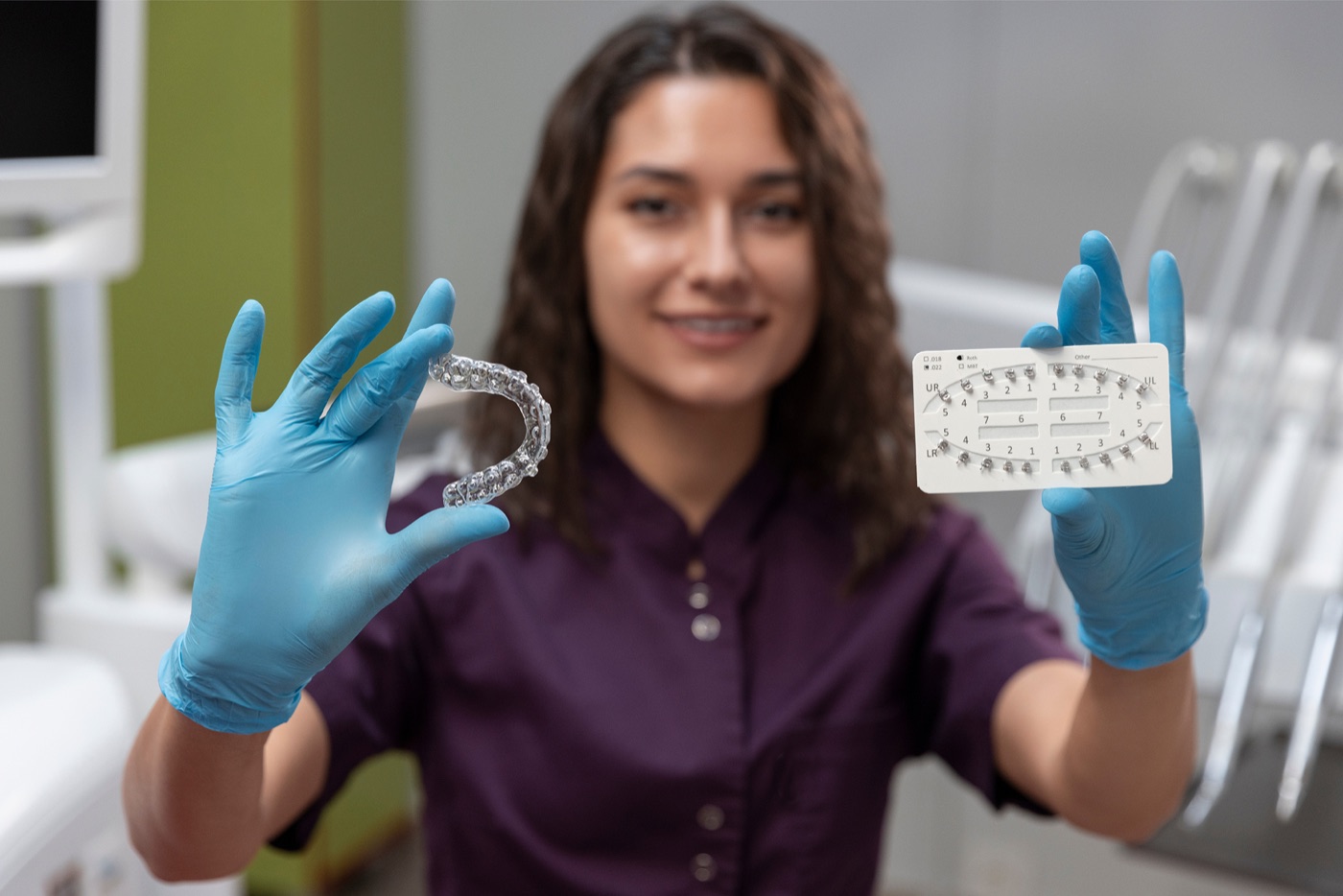
| Factor | Traditional Braces | Invisalign™ |
|---|---|---|
| Appearance | Visible metal brackets and wires | Virtually invisible clear aligners |
| Comfort | Can irritate cheeks and lips; soreness after tightening | Smooth plastic; mild pressure when switching trays |
| Removable | No — fixed to teeth for full treatment | Yes — remove for eating, brushing, and special events |
| Food Restrictions | Yes — no sticky, hard, or chewy foods | None — eat whatever you want |
| Treatment Time | 12–24 months average | 6–18 months average |
| Office Visits | Every 4–6 weeks for adjustments | Every 6–8 weeks for progress checks |
| Best For | Severe crowding, complex bite issues, younger patients | Mild-to-moderate cases, adults, professionals, teens |
| Cost | Comparable to Invisalign™ | Starting at $2,998 — comparable to braces |
| Compliance Required | None — always working | Must wear 20–22 hours/day for best results |
Cases Where Braces May Be the Right Choice
Traditional braces remain the gold standard for certain complex orthodontic cases. They offer constant, non-stop force on your teeth — no compliance required — and can handle movements that aligners struggle with.
- Severe crowding requiring significant tooth movement
- Complex bite corrections (deep overbite, severe crossbite)
- Tooth rotations greater than 20 degrees
- Young patients who may not wear aligners consistently
- Cases requiring vertical tooth movement (intrusion/extrusion)
Cases Where Invisalign™ Shines
Invisalign™ handles the majority of orthodontic cases — and offers lifestyle advantages that braces simply can’t match. If your case falls in the mild-to-moderate range, clear aligners are hard to beat.
- Mild-to-moderate crowding and spacing
- Professionals who need a discreet option
- Adults who never had braces and want a subtle correction
- Teens who are motivated and will wear aligners consistently
- Patients who want to eat without restrictions
- Anyone who values comfort and fewer office visits

Dr. Sepideh Dolatyar
Whether braces or Invisalign™ is right for you, your treatment is planned and supervised by Dr. Dolatyar, our board-certified orthodontist specializing in Invisalign™ and clear aligner therapy — from simple crowding to complex bite correction, with office visits every 2–4 weeks.
Explore Invisalign™ & Orthodontics
Find detailed information about your options at Island Dental.
Invisalign™ Overview
Full overview of all orthodontic options we offer.
Invisalign™ for Teens
Clear aligners designed for adolescent lifestyles.
Invisalign™ for Adults
Discreet teeth straightening for professionals.
Cost & Financing
Pricing, insurance coverage, and 0% financing options.
The Process
From iTero scan to final smile — what to expect.
Retainers & Aftercare
Protect your investment with custom retainers.
Braces vs. Invisalign™ FAQs
For mild-to-moderate cases, Invisalign™ is often faster — sometimes completing treatment in as little as 6 months. Complex cases may take longer with either option. Your orthodontist can give you an estimated timeline for both at your free consultation.
The cost is comparable for most cases. Invisalign™ at Island Dental starts at $2,998. Insurance covers both similarly, and the same 0% financing options apply to both. Cost alone shouldn’t be the deciding factor. We offer clear and metal braces.
Yes, Invisalign™ can correct mild-to-moderate overbites effectively. Severe overbites may respond better to braces with elastics. Our orthodontist evaluates your specific bite and recommends the best approach.
In some cases, yes. Patients who started with braces to address the most complex movements can sometimes transition to Invisalign™ for the finishing stages. Our orthodontist can evaluate whether this makes sense for your case.
There’s no upper age limit for either option. Adults of any age can straighten their teeth. For younger patients, braces can start once permanent teeth have erupted. Invisalign™ Teen is appropriate from about age 12–14. Our free consultation determines the best timing and option.
No matching questions. Try a different word, or ask us directly.